
LEADERSHIP
WARP SPEED LEADERSHIP · DONAL BAILEY
AI is part of the work.
The responsibility
is still yours.
See the leadership question inside the AI headline. Clear thinking, considered evidence, and questions for the decisions you own.
For senior leaders. Every two weeks. Written to be used.
Executive counsel / Warp Speed Leadership / The AI Didn’t Do It
THE PUBLICATION
Something worth taking
into your next meeting.
AI can produce a convincing answer before an organization has understood the question. Your task is to decide what deserves confidence, what needs another check, and who owns what follows.
Each briefing examines a consequential development or recognizable leadership situation, then gives you a practical way to work through it.
A situation that matters.
A reported development or a clearly identified example close to the work senior leaders carry.
A considered interpretation.
The leadership choice beneath the headline, with evidence distinguished from commentary.
A question to put to work.
A practical prompt or visual instrument for your next decision, brief, or conversation.
READ BEFORE YOU SUBSCRIBE
SAMPLE BRIEFING · ABOUT 4 MINUTESBefore you approve
the AI brief.
Which claim carries the decision, and who has checked that it deserves the weight?
A government commissioned a health-workforce report. Later, some of the sources cited in it appeared not to exist.
In March 2026, The Canadian Press reported that Newfoundland and Labrador had changed its procurement procedures after false citations surfaced in two reports, including one prepared by Deloitte Canada. Suppliers would have to disclose intended AI use, and the province could examine that use.
Deloitte said AI had supported a small number of research citations, denied that AI wrote the report, and stood behind its recommendations. It said citation corrections had been made. Read the reporting ↗︎
That distinction matters. Citation errors do not, by themselves, establish that a recommendation is wrong. They do leave the person relying on it with an uncomfortable question:
What was checked before this became something I was expected to trust?
Continue reading the full briefing
You don’t need a government contract to encounter that question.
Consider an illustrative situation. Your leadership team is reviewing a proposal to expand an AI pilot. The recommendation is clear, the financial case is attractive, and the brief anticipates the obvious objections.
You ask what supports the projected saving.
The executive presenting it points to a benchmark in the appendix. Someone on the team found it. The supplier’s presentation used a similar figure. Finance has checked the arithmetic.
You still need to know whether the benchmark describes work sufficiently like yours. The calculation may be correct while the assumption carrying it remains untested.
This is where I would slow the conversation.
A document can become more persuasive as it passes through an organization. Each person improves something: the analysis, the wording, the presentation. By the time it reaches you, it can be difficult to see which parts were independently established and which parts acquired credibility through repetition.
Your approval gives the recommendation another kind of authority. It also gives the organization permission to act.
Before that happens, stay with the person making the recommendation.
“What persuaded you?”
Give them time to answer. They may explain why a particular piece of evidence matters. They may identify a trade-off they believe is acceptable. They may also discover that the brief is more definite than their own judgment.
That discovery is useful, provided the room can tolerate it.
If uncertainty is treated as evidence of poor preparation, people learn to arrive with smoother explanations. You can end up with greater confidence in the meeting and less understanding of the decision.
Try it on one decision this week.
Ask its owner to identify the claim most likely to change the decision if it proved wrong. Then ask for the original evidence behind that claim and a short explanation of why it applies here.
Suppose a proposal says an AI service will reduce handling time by 30 percent. Finding the source of that figure is the beginning. You still need to understand what was measured, what work was excluded, and whether the comparison includes the time people spend checking and correcting the output.
Those are questions about the decision you are making.
You may conclude that the evidence is strong enough to proceed. You may approve a smaller test or require another check. You may decide that the opportunity warrants accepting some uncertainty.
Whichever choice you make, name the uncertainty you are accepting and the evidence that would cause you to revisit it. That leaves the executive with a recommendation they can own, and you with an approval you can explain.
Before the next brief enters the meeting pack, try this question:
“Which claim are we relying on most, and who has checked that it deserves the weight we’re putting on it?”
The answer may be straightforward. If it isn’t, you have found work worth doing before the decision travels any further.
Donal
This briefing develops a theme explored in The AI Didn’t Do It: how leaders establish understanding and ownership when AI participates in the work.
THE EXECUTIVE CHECK
Keep the decision traceable to its evidence.
- 01
Evidence
Is the source real
and reliable? - 02
Interpretation
Does it apply
to our situation? - 03
Recommendation
Why this action
over the alternatives? - 04
Approval
What uncertainty
are we accepting?
ORIGINAL CONCEPTUAL EXHIBIT · DONAL BAILEY
THE QUESTIONS AHEAD
Stay close to
the decisions that matter.
CONTINUE THE THINKING
A useful pause.
Every two weeks.
A personal briefing for senior leaders making consequential decisions as AI changes how work gets done.
Receive the next briefing.
By subscribing, you agree to receive Warp Speed Leadership every two weeks and occasional updates about my books and audiobooks. Unsubscribe at any time.
Follow Donal on LinkedIn ↗︎THE BOOKS BEHIND THE THINKING
Go further.
Practical leadership for organizations learning to work with AI.
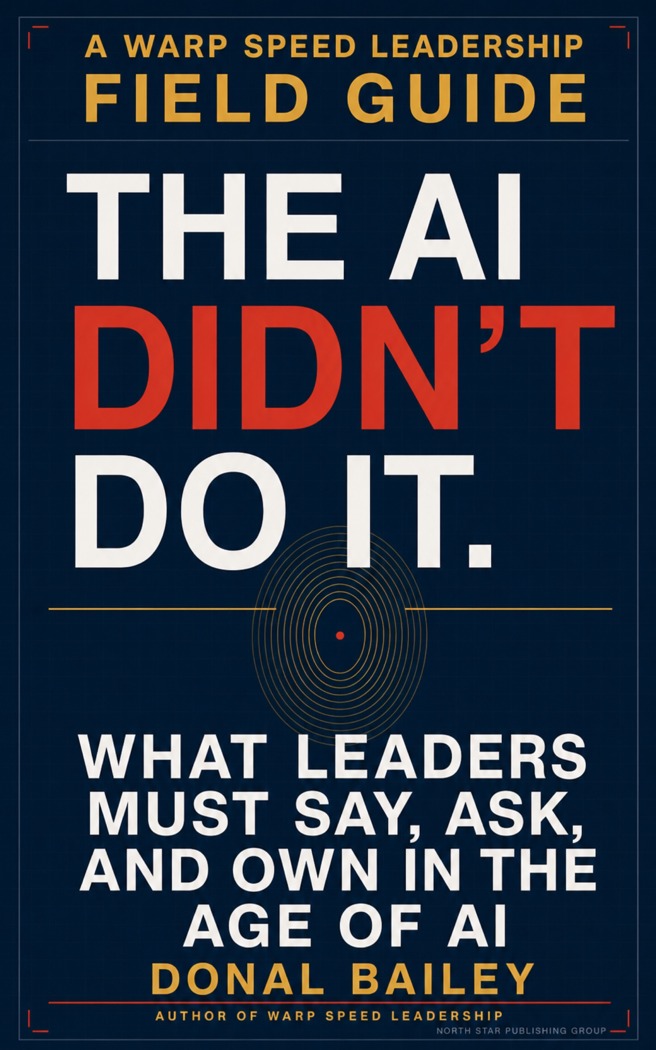
The AI Didn’t Do It
Questions, language, and practices for closing the gap between how work is produced and how it is understood, governed, and owned.
Explore the book ↗︎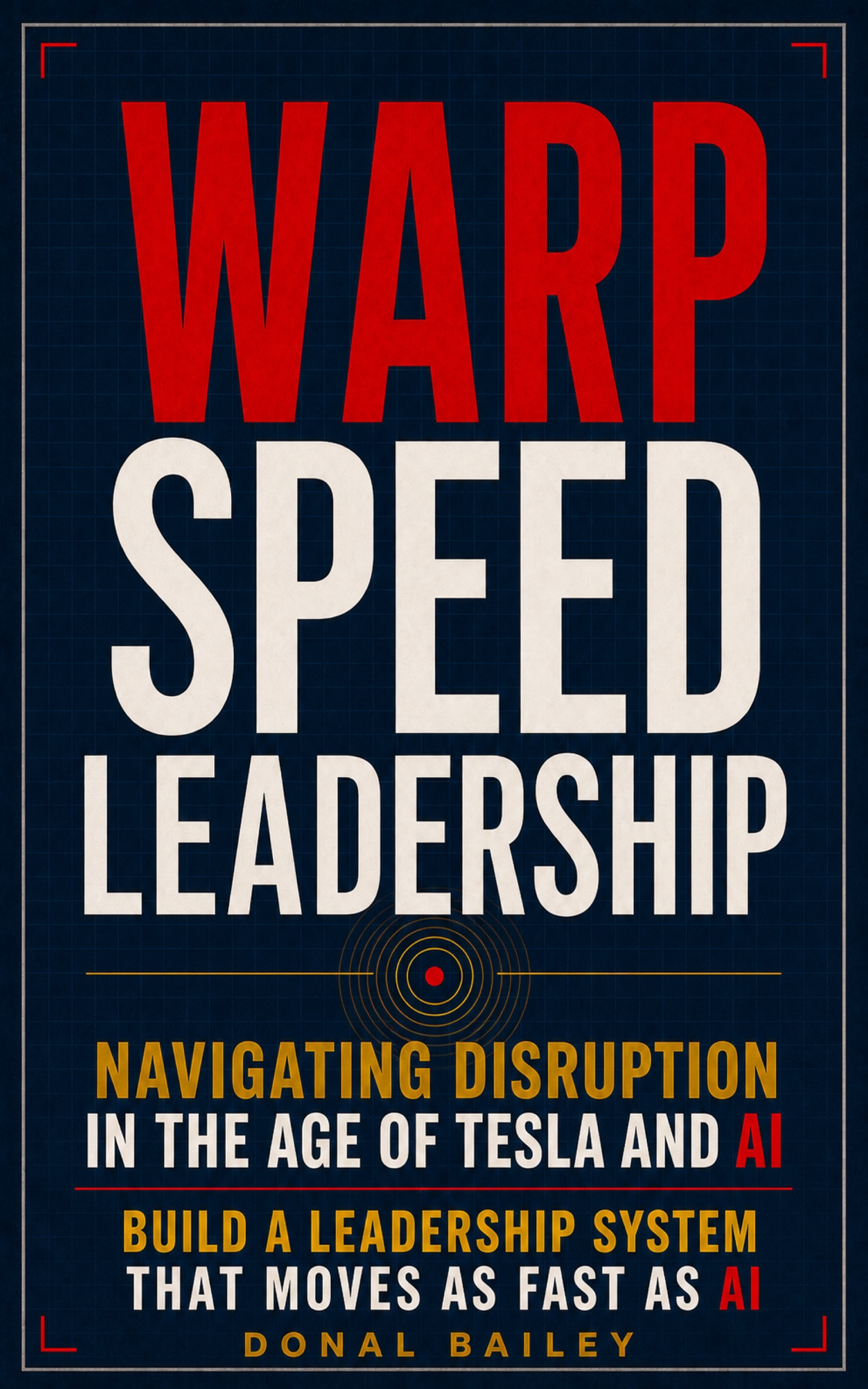
Warp Speed Leadership
Examining organizational learning, adaptation, and the leadership trade-offs behind the pursuit of speed.
Explore the book ↗︎PRESS RELEASES
Warp Speed Leadership in the public conversation.
Explore North Star Publishing Group’s announcements about the book and the leadership questions behind it.
Book launch and the changing leadership agenda ↗︎
The operating model behind SpaceX ↗︎
Publisher-issued releases distributed through EIN Presswire.
DONAL BAILEY
The question beneath
the first answer.
Donal Bailey is an executive coach and the author of Warp Speed Leadership and The AI Didn’t Do It, published by North Star Publishing Group.
His work examines how senior leaders exercise judgment and responsibility when technological change moves faster than their organizations were designed to absorb.
Connect with Donal on LinkedIn ↗︎